
Repmold is an emerging term in manufacturing circles that describes a digital-first approach to making, repairing, and replicating molds. If you’ve been hearing the word pop up in prototyping or tooling conversations and aren’t sure whether it’s a product, a process, or just industry jargon, this guide breaks it down in plain terms.
Quick Answer
Repmold is a digital-driven approach to mold making that combines 3D scanning, CAD design, and 3D printing to repair worn tooling or replicate molds faster than traditional machining allows. It’s used mainly for prototyping, short production runs, and restoring damaged molds without scrapping the original tooling. Note: repmold isn’t a formally standardized industry term with a single accepted definition usage varies depending on the source, so treat specifics as general guidance rather than a fixed spec.
What Is Repmold, Exactly?
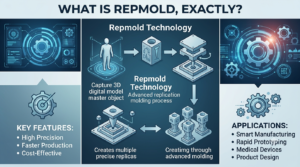
At a basic level, repmold refers to the practice of using digital tools 3D scanners, CAD software, and additive manufacturing to reproduce or restore a mold instead of building one from scratch with conventional machining. The name itself is a shorthand blend of “replicate” and “mold,” and it’s used somewhat loosely across different sources, sometimes to mean mold repair, other times mold replication, and occasionally both.
Where the Term Comes From

Repmold doesn’t trace back to a single company, inventor, or patent. Instead, it grew out of decades of progress in additive manufacturing:
- 1981 Dr. Hideo Kodama published early research on layer-by-layer resin curing, a foundational idea behind 3D printing.
- 1984 Chuck Hull filed the patent for stereolithography (SLA), enabling precise, smooth printed parts.
- Later years Carl Deckard’s work on selective laser sintering (SLS) added powder-based printing to the toolkit, giving engineers stronger printed components to work with.
As these technologies matured and became affordable enough for small manufacturers, the practice of scanning a part, cleaning up the model in CAD, and printing or casting a replacement mold became common enough to earn its own shorthand: repmold.
How Does Repmold Work?
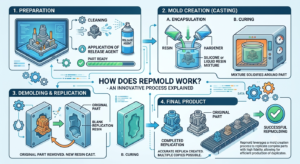
The general workflow looks like this:
- Capture the geometry. A technician either 3D-scans an existing part or mold, or draws a new one in CAD software (software used to design precise 2D or 3D models on a computer).
- Clean and convert the model. The scanned or drawn file is corrected for errors and converted into a mold cavity essentially, the digital inverse of the part shape.
- Produce the mold. The mold is 3D-printed directly, or the printed model is used as a pattern for casting a mold in silicone, resin, or metal.
- Cast or mold the part. The finished mold is used for injection molding, resin casting, or vacuum forming to produce test parts or a short batch of finished ones.
Repair vs. Replication
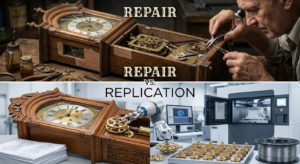
It helps to separate the two common uses of the term:
- Repmold as repair an old or damaged mold is scanned, its worn geometry is corrected in software, and a restored version is produced, extending the life of tooling that would otherwise be scrapped.
- Repmold as replication a mold is recreated from scratch based on an existing part, useful when the original mold no longer exists or when a manufacturer needs a spare.
Why Does Repmold Matter?
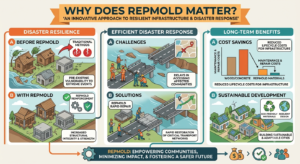
Traditional mold-making particularly for injection molding or die casting typically requires machining a steel or aluminum tool, which is expensive and slow. A single production mold can take weeks to manufacture and cost a significant amount before a single part is produced (cite source here). Repmold-style processes compress that timeline by relying on scanning and printing instead of subtractive machining for early-stage or lower-volume needs.
This matters most to:
- Product designers who need to iterate on a part shape multiple times before committing to expensive production tooling.
- Maintenance teams in factories who need a fast replacement for a broken mold and can’t wait weeks for a new one to be machined.
- Small manufacturers and startups who can’t justify the upfront cost of traditional tooling for short production runs.
Real-World Use Cases

- Automotive aftermarket parts. A shop restoring an older vehicle scans a discontinued trim piece, then uses a repmold-style process to produce a small batch of replacements instead of sourcing an original mold that no longer exists.
- Consumer product prototyping. A startup testing a new plastic housing design scans a 3D-printed prototype, converts it into a mold cavity, and produces a handful of test units in the target material before investing in production-grade steel tooling.
Repmold vs. Traditional Mold Making
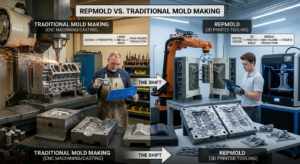
| Factor | Traditional Mold Making | Repmold-Style Process |
|---|---|---|
| Typical lead time | Weeks to months | Days to a couple of weeks |
| Upfront cost | High (machined steel/aluminum tooling) | Lower (digital tools + printing materials) |
| Best for | Large production runs | Prototypes, short runs, repairs |
| Design flexibility | Costly to change once tooling is cut | Easy to revise the digital model |
| Mold durability | Very high, built for thousands of cycles | Moderate, depends on print material |
| Skill/equipment needed | CNC machining, mold-making expertise | 3D scanner, CAD software, 3D printer |
Is Repmold Worth It in 2026?
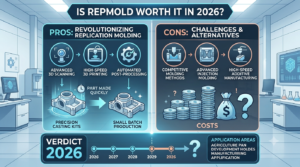
It depends on volume and purpose. For anyone producing tens of thousands of identical parts, conventional steel tooling still wins on durability and per-unit cost. For prototyping, low-volume production, or emergency repairs, a repmold-style workflow can save real time and money.
Common Mistakes to Avoid
- Skipping post-scan cleanup. Raw scan data almost always has noise or gaps that need manual correction in CAD before it’s usable as a mold cavity.
- Choosing the wrong print material. Not all 3D-printed resins or filaments hold up to injection molding temperatures or repeated casting cycles — material selection matters as much as the geometry.
- Underestimating shrinkage and tolerances. Printed molds can behave differently than machined ones when materials cool or cure, so test parts should be checked against tolerances before committing to a full run.
Key Takeaways
- Repmold is a digital approach to mold making that combines 3D scanning, CAD modeling, and 3D printing instead of relying solely on conventional machining.
- It’s used for two main purposes: repairing worn or damaged molds and replicating molds that no longer exist.
- It’s best suited for prototypes, short production runs, and urgent repairs rather than high-volume manufacturing.
- Traditional steel tooling remains superior for large-scale production in terms of durability and long-term per-unit cost.
- Success depends on careful scan cleanup, correct material choice, and tolerance testing before a mold is used for a full production run.
FAQs
QIs repmold a specific product or company?
No. Repmold is a descriptive term for a process combining 3D scanning, CAD, and 3D printing to make or repair molds rather than a single branded product or company.
QCan repmold replace injection molding entirely?
Not for high-volume production. Repmold-style processes are generally better suited to prototypes, repairs, and short runs, while conventional steel or aluminum tooling still performs better for large production volumes.
Q What equipment do I need to try a repmold-style workflow?
At minimum, you’ll need a 3D scanner (or CAD skills to model the part digitally), design software to clean up and convert the scan into a mold cavity, and access to a 3D printer capable of producing the mold or a pattern for casting.
Q How long does a repmold process typically take compared to traditional tooling?
A repmold-style mold can often be produced in days rather than the weeks or months typical of machined production tooling, though exact timelines depend on part complexity and the printer or materials used.
Q Is repmold suitable for repairing broken industrial molds?
Yes repairing worn or damaged molds by scanning the original geometry and reproducing a corrected version is one of the two most common uses of the term.