
The 9 square game is a fast-paced group activity that combines volleyball-style passing with quick decision-making, teamwork, and friendly competition. Whether you’re organizing a school event, youth group, church gathering, or team-building session, learning the rules and strategies of the 9 square game can help you create an engaging experience for players of all ages.
Unlike traditional sports that require extensive equipment or athletic ability, the 9 square game is easy to learn but challenging to master. In this guide, you’ll discover how the game works, the official rules, popular variations, winning strategies, and why it has become one of the most popular recreational games in schools and community events.
Quick Answer
The 9 square game is a multiplayer game played inside a three-by-three grid where players hit a ball upward into another player’s square without letting it bounce twice or go out of bounds. The objective is to advance to the center “King” square by successfully returning the ball while eliminating opponents through legal gameplay.
Table of Contents
- What Is the 9 Square Game?
- How Does the 9 Square Game Work?
- What Equipment Do You Need for the 9 Square Game?
- What Are the Official 9 Square Game Rules?
- What Strategies Help You Win the 9 Square Game?
- Who Can Play the 9 Square Game?
- 9 Square Game vs Four Square
- Why Is the 9 Square Game So Popular?
- Key Takeaways
- Frequently Asked Questions
What Is the 9 Square Game?
The 9 square game is a multiplayer outdoor or indoor game that combines elements of volleyball and four square using a raised three-by-three grid.
Instead of bouncing a ball on the ground, players volley it over PVC pipes that divide nine elevated squares. Each participant occupies one square and attempts to keep the ball in play while sending it into another player’s square.
The game is designed for:
- Schools
- Churches
- Youth camps
- Recreation centers
- Family gatherings
- Corporate team-building events
Because it accommodates nine active players plus a waiting line, nearly everyone gets a chance to participate without long delays.
outdoor games for large groups]
How Does the 9 Square Game Work?
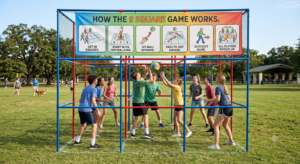
The game begins with one player occupying each square.
The center square is considered the highest-ranking position, often called the King square. Other surrounding squares have lower ranks.
Basic Gameplay
- The King serves the ball upward.
- The server directs the ball into another player’s square.
- The receiving player must hit the ball upward before it bounces twice.
- The ball continues around the grid.
- Players are eliminated if they break a rule.
- Eliminated players leave the grid.
- Everyone below moves up one position.
- A new player enters the lowest-ranked square.
This rotation keeps the game moving continuously.
What Equipment Do You Need for the 9 Square Game?
The game requires surprisingly little equipment.
| Equipment | Purpose | Required |
|---|---|---|
| 9 Square PVC Frame | Creates the elevated grid | Yes |
| Playground Ball | Used during gameplay | Yes |
| Flat Playing Surface | Safe movement | Yes |
| Air Pump | Maintains proper ball pressure | Recommended |
| Boundary Markers | Defines play area | Optional |
Many commercial kits use lightweight PVC construction that assembles in minutes.
What Are the Official 9 Square Game Rules?
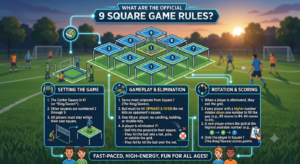
While local groups sometimes modify the rules, most games follow similar standards.
Serving Rules
- The King always serves.
- The ball must travel upward before entering another square.
- The serve cannot be excessively hard unless local rules allow it.
- Every serve must land inside a legal square.
Returning the Ball
Players may:
- Hit the ball with open hands.
- Volley using one or both hands.
- Redirect the ball into any legal square.
Players usually cannot:
- Catch the ball.
- Hold the ball.
- Throw the ball.
- Hit the frame intentionally.
Ways Players Get Out
A player is eliminated if they:
- Let the ball bounce twice.
- Hit the ball outside the grid.
- Hit the frame before the ball crosses.
- Catch or carry the ball.
- Strike the ball illegally.
- Touch the frame during play.
Individual organizations sometimes create house rules, so it’s worth agreeing on them before the game starts.
What Strategies Help You Win the 9 Square Game?
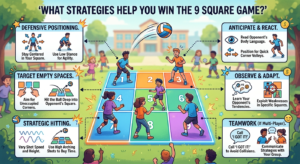
Winning consistently requires more than simply hitting the ball.
Stay Ready
Keep your knees bent and remain balanced.
Since the ball can arrive from any direction, positioning matters more than power.
Watch the King’s Movements
Experienced players often predict where the King prefers to serve.
Recognizing patterns gives you valuable reaction time.
Use Soft Placement
Instead of hitting hard every time, aim for open spaces.
Controlled placement often causes more eliminations than powerful shots.
Communicate During Casual Games
When playing with friends or teammates, calling out the ball can reduce confusion.
Although every player defends only their own square, communication improves reaction speed.
Avoid Risky Shots
Many players lose their turn by attempting spectacular spikes.
A simple controlled volley usually keeps you in the game longer.
Who Can Play the 9 Square Game?
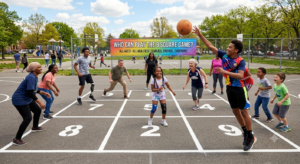
One of the biggest strengths of the 9 square game is accessibility.
Most versions work well for:
- Children
- Teenagers
- Adults
- Families
- Youth ministries
- Summer camps
- Physical education classes
Example 1: School PE Class
A physical education teacher can divide 30 students into rotating groups. While nine students play, others wait only a short time before entering.
This keeps participation high compared to games where students spend long periods on the sidelines.
Example 2: Corporate Team Building
Companies frequently use the game during outdoor events because it encourages communication, quick thinking, and friendly competition without requiring advanced athletic skills.
9 Square Game vs Four Square
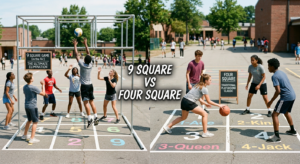
Although the games share similarities, they play quite differently.
| Feature | 9 Square Game | Four Square |
|---|---|---|
| Number of Players | 9 | 4 |
| Ball Movement | Volley in air | Bounce on ground |
| Court Design | Elevated PVC grid | Ground court |
| Physical Demand | Moderate | Moderate |
| Waiting Time | Usually shorter | Can be longer |
| Best For | Large groups | Smaller groups |
The elevated structure creates a unique style of gameplay that emphasizes hand-eye coordination instead of ground bounces.
Why Is the 9 Square Game So Popular?
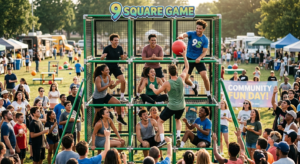
Several factors explain its growing popularity.
Easy to Learn
New players often understand the basics within five minutes.
Keeps Large Groups Engaged
Unlike many games where players wait for long turns, eliminated participants quickly rotate back into play.
Encourages Social Interaction
Players naturally laugh, communicate, and cheer one another throughout each round.
Suitable for Multiple Skill Levels
Children and adults can often compete together by adjusting house rules.
Portable Equipment
Most commercial systems can be assembled and transported without specialized tools.
According to youth recreation organizations, group games that encourage active participation can improve engagement and teamwork when compared with passive activities (cite source here).
Common Mistakes New Players Make
Many beginners struggle because they focus only on power.
Common mistakes include:
- Standing flat-footed
- Hitting the ball too hard
- Ignoring positioning
- Forgetting rotation rules
- Watching only the ball instead of other players
Experienced organizers also recommend checking the frame’s stability before every game and ensuring adequate spacing around the court for safety.
Practical Tips Before Buying a 9 Square Set
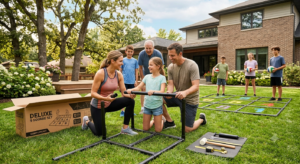
If you’re purchasing equipment for a school or organization, verify:
- Frame durability
- Weather resistance
- Assembly time
- Replacement part availability
- Ball compatibility
- Warranty coverage
best outdoor games for schools]
Key Takeaways
- The 9 square game combines volleyball mechanics with a raised nine-square court to create an engaging multiplayer activity.
- The center King square serves first, and players rotate upward as opponents are eliminated.
- Soft placement and positioning are often more effective than powerful hits.
- The game works well for schools, churches, camps, family gatherings, and corporate events.
- Simple equipment and easy-to-learn rules make the 9 square game accessible for nearly all age groups.
Conclusion
The 9 square game stands out because it blends simple rules with energetic, social gameplay that keeps large groups involved. Whether you’re introducing it in a classroom, organizing a church youth event, or planning a company picnic, it offers an excellent balance of competition and accessibility. Players don’t need advanced athletic skills to enjoy the experience, yet there’s enough strategy to keep experienced participants challenged.
If you’re looking for a fun activity that encourages movement, teamwork, and quick thinking, the 9 square game is an excellent choice. Learn the basic rules, agree on any house variations before you begin, and focus on consistent play rather than power—you’ll have an enjoyable game that players are eager to return to.
FAQs
What is the objective of the 9 square game?
The objective of the 9 square game is to stay in play by successfully volleying the ball into another player’s square while avoiding rule violations. Players aim to advance into the center King square, which is the highest-ranking position on the court.
How many players are needed for the 9 square game?
A standard game accommodates nine active players, one in each square. Additional participants typically wait in a rotation line and enter the game whenever someone is eliminated.
Is the 9 square game suitable for young children?
Yes. The game is commonly adapted for younger players by using softer balls, slower serves, or simplified rules. These adjustments make it enjoyable for children while maintaining the core gameplay.
Can the 9 square game be played indoors?
Yes, provided there is enough ceiling height and floor space. Schools, gyms, and recreation centers often host indoor games using portable PVC frames.
What skills does the 9 square game improve?
The game helps develop hand-eye coordination, reaction time, communication, balance, and teamwork. It also encourages physical activity and social interaction, making it a popular choice for educational and recreational settings.